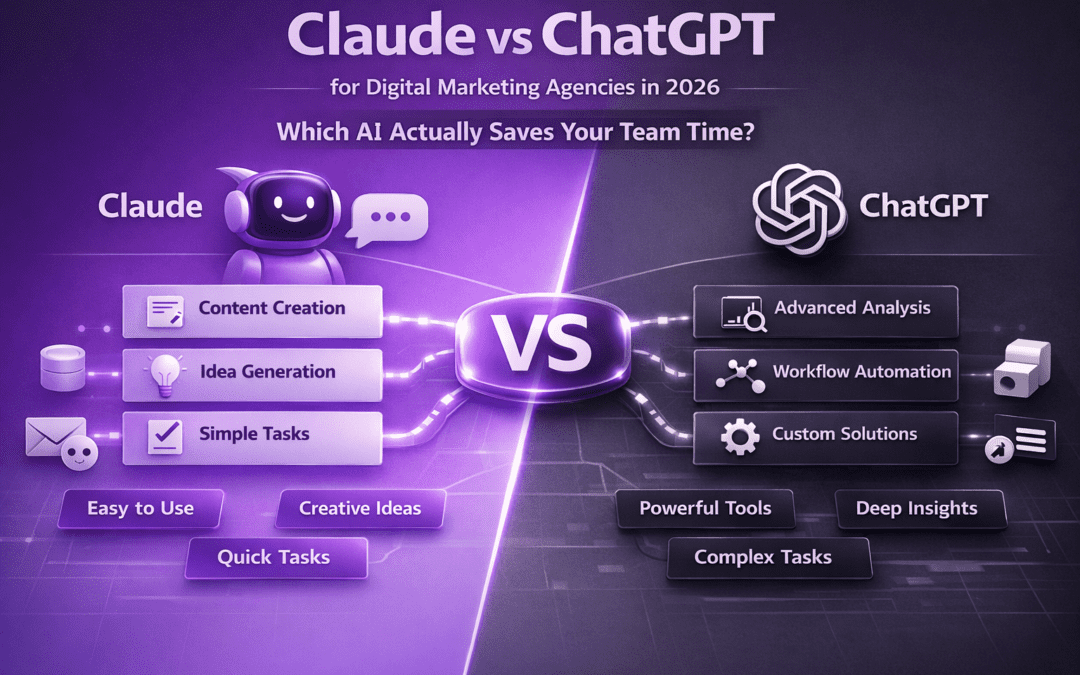
You have twenty minutes before a client calls. Three deliverables are sitting half-finished in your tabs an SEO blog draft, a set of ad variations, and a month’s worth of LinkedIn posts. You open your AI tool. And right there, the question surfaces again: am I even using the right one?
It is a question that is costing digital marketing agencies real money in 2026. Not in subscription fees both Claude and ChatGPT sit at $20 a month for their Pro tiers. The cost is invisible. It lives in editing rounds that should not have happened, prompts that do not quite land, context lost halfway through a complex brief. If you are running a 5-person agency using the wrong AI tool for your business for the wrong tasks, you are quietly losing 5 to 8 hours of billable capacity every single week.
At Gonzo Digital, we spent 30 days running both Claude and ChatGPT through six real agency workflows. Not benchmark scores. Not theoretical use cases. Just actual production tasks: SEO articles, ad copy, social media calendars, client performance reports, email campaigns, and no-code automation builds. This is the Claude vs ChatGPT for business, we wish it had existed when we started making these decisions ourselves.
This guide exists to close that gap. By the end, you will have a complete Claude vs ChatGPT comparison for every major agency workflow, clear pricing data at every tier, real time-savings numbers from 30 days of testing, and a practical decision framework for building a dual-tool strategy that actually works.
Claude vs ChatGPT For Business 2026: Quick Verdict by Use Case
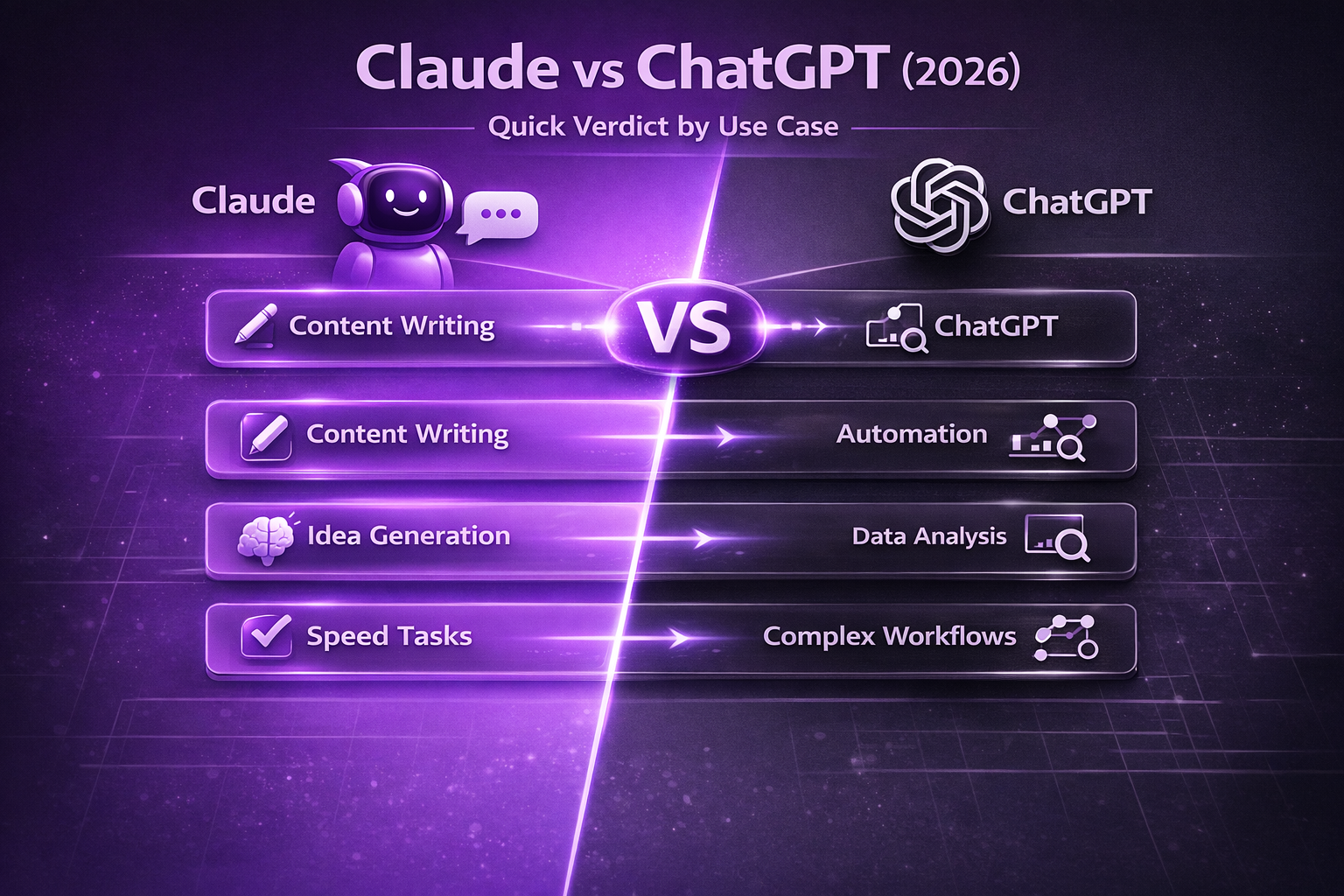
If you are short on time, this table is the answer. Bookmark it, screenshot it, share it with your team. The full breakdown follows in each section below but this gives you the decision framework at a glance:
| Use Case | Winner 2026 | Claude — why it wins | ChatGPT — why it wins |
|---|---|---|---|
| SEO Blog Writing | Claude | Follows briefs faithfully; natural writing style; 200K context handles full datasets | Good drafts but needs more post-editing for tone and structure |
| Social Media Content | Claude | Avoids generic AI openers; LinkedIn posts feel practitioner-written | Strong volume output but formulaic structure |
| Ad Copy & A/B Testing | ChatGPT | Faster variation generation; genuinely distinct angle options per prompt | High quality but slower to produce large copy batches |
| Client Reports & Analysis | Claude | Full dataset in one 200K prompt; fewer hallucinations on data synthesis | 128K limit means chunking long reports across multiple prompts |
| No-Code Automation (Zapier) | ChatGPT | Larger pre-built integration library; fastest path to working Zaps | Strong API but fewer out-of-the-box connectors |
| Custom Workflows (Make/n8n) | Claude | More precise instruction-following in multi-step agentic sequences | Works but requires more prompt engineering overhead |
| Image Generation | ChatGPT | DALL-E built in — text and image in one workflow | Does not generate images natively |
| Pricing (Pro tier) | Tied | Claude Pro: $20/month | ChatGPT Plus: $20/month |
The honest takeaway: neither tool dominates everything. Claude wins the quality-intensive, long-context, and instruction-heavy tasks. ChatGPT wins where speed, volume, and ecosystem breadth matter. The agencies extracting the most value from AI in 2026 are not loyal to one platform — they are strategic about which AI tool actually saves time for each specific job.
According to DemandSage’s 2026 Claude statistics report, ChatGPT currently has approximately 900 million weekly active users globally, while Claude has reached 18.9 million monthly active users — growing at 14% per quarter, making it the fastest-growing major AI platform. More significantly, around 80% of Anthropic’s revenue comes from business customers rather than consumers, which tells you something important about where Claude AI for business productivity is winning in practice.
Claude vs ChatGPT Pricing for Business Teams in 2026
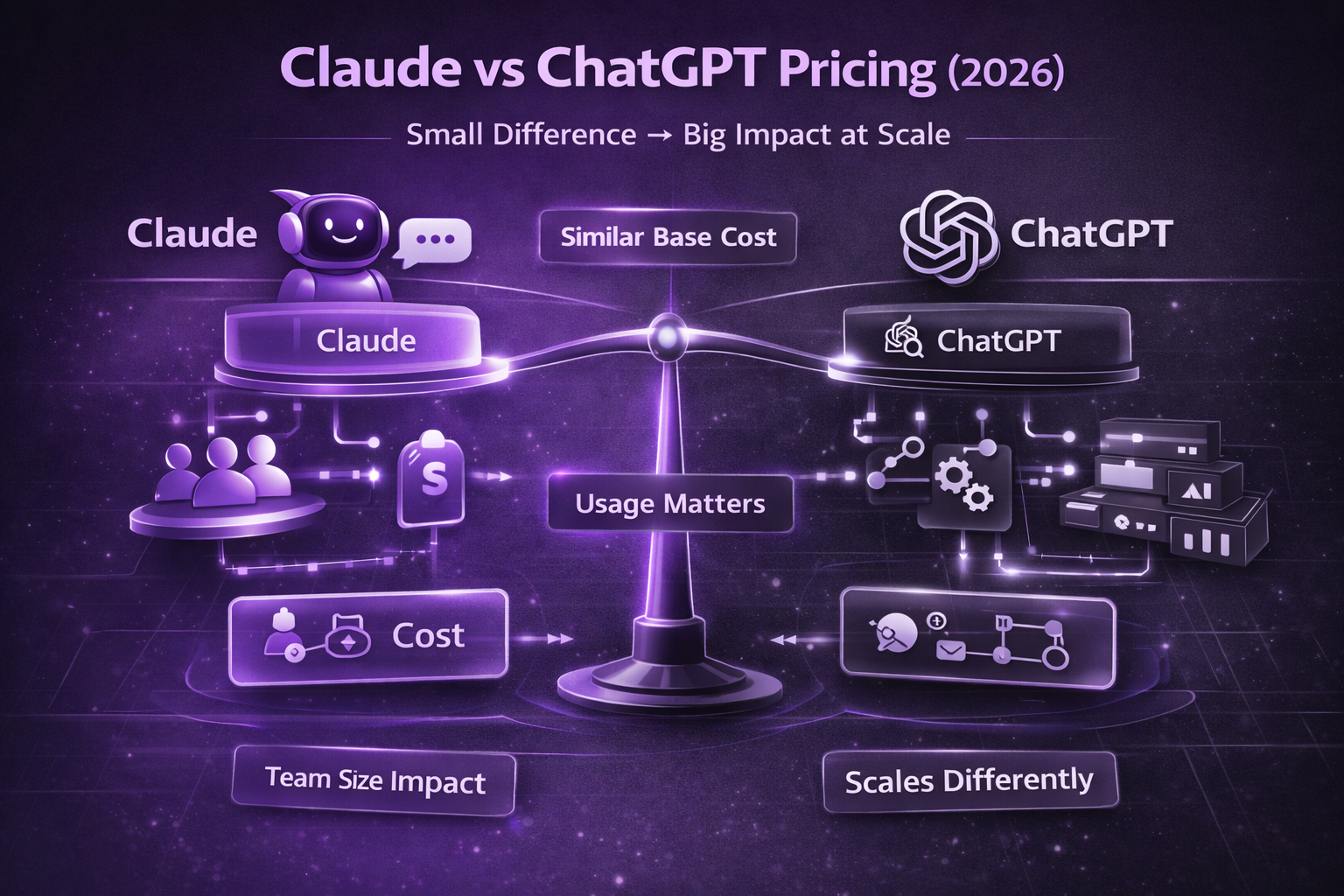
Before we get into what each tool actually does in practice, pricing needs to be understood clearly — because the numbers are closer than most people realise, and the differences only become meaningful at scale or at the API level.
| Plan | Claude | ChatGPT | Key difference |
|---|---|---|---|
| Free tier | Claude.ai free — Sonnet 4.6, daily caps | ChatGPT free — GPT-5.3, limited | Both free tiers are genuinely capable in 2026 |
| Pro / Plus | $20/month (or $17/mo annually) | $20/month | Identical pricing — choose on features, not cost |
| Mid-tier | Not available | ChatGPT Go: $8/month | ChatGPT has a lower entry point for occasional users |
| Max / Pro (Power) | Claude Max: $100–$200/month | ChatGPT Pro: $200/month | Both top tiers are comparable |
| Team plan | $25–$30/user/month | $25/user (annual) or $30/user (monthly) | Claude slightly cheaper on annual billing |
| Enterprise | Custom — sales call required | Custom — sales call required | Both require direct contact |
| API — input tokens | $3.00 per 1M tokens (Sonnet 4.6) | $2.50 per 1M tokens (GPT-5.4) | ChatGPT cheaper for high-volume API workloads |
| API — output tokens | $15.00 per 1M tokens | $10.00 per 1M tokens | ChatGPT significantly cheaper for output-heavy pipelines |
| Context window (paid) | 200,000 tokens standard | 128,000 tokens (most paid plans) | Claude’s larger window matters for long documents |
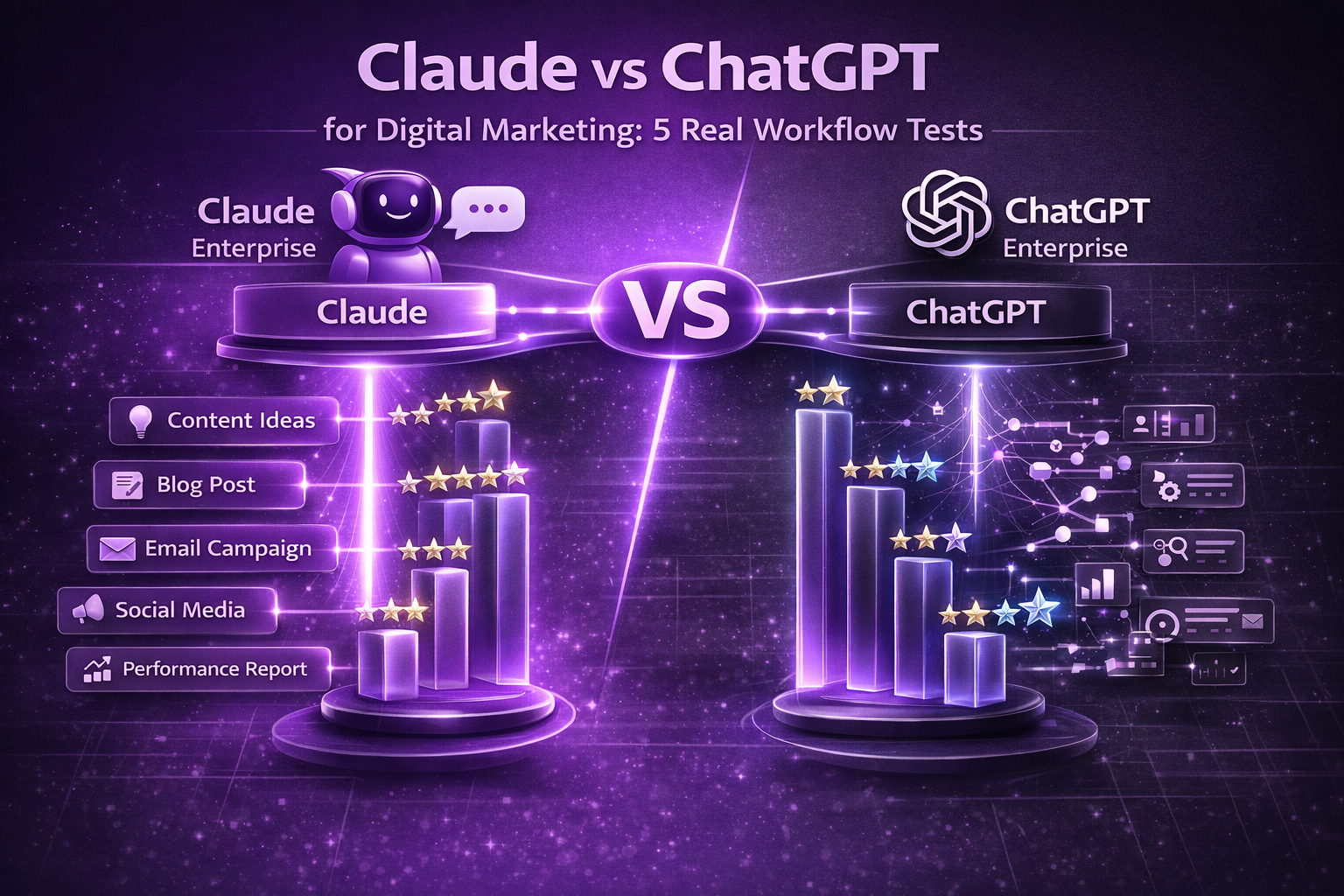
Claude vs ChatGPT for Digital Marketing: 5 Real Workflow Tests
Test 1: Writing Blog Posts and SEO Content
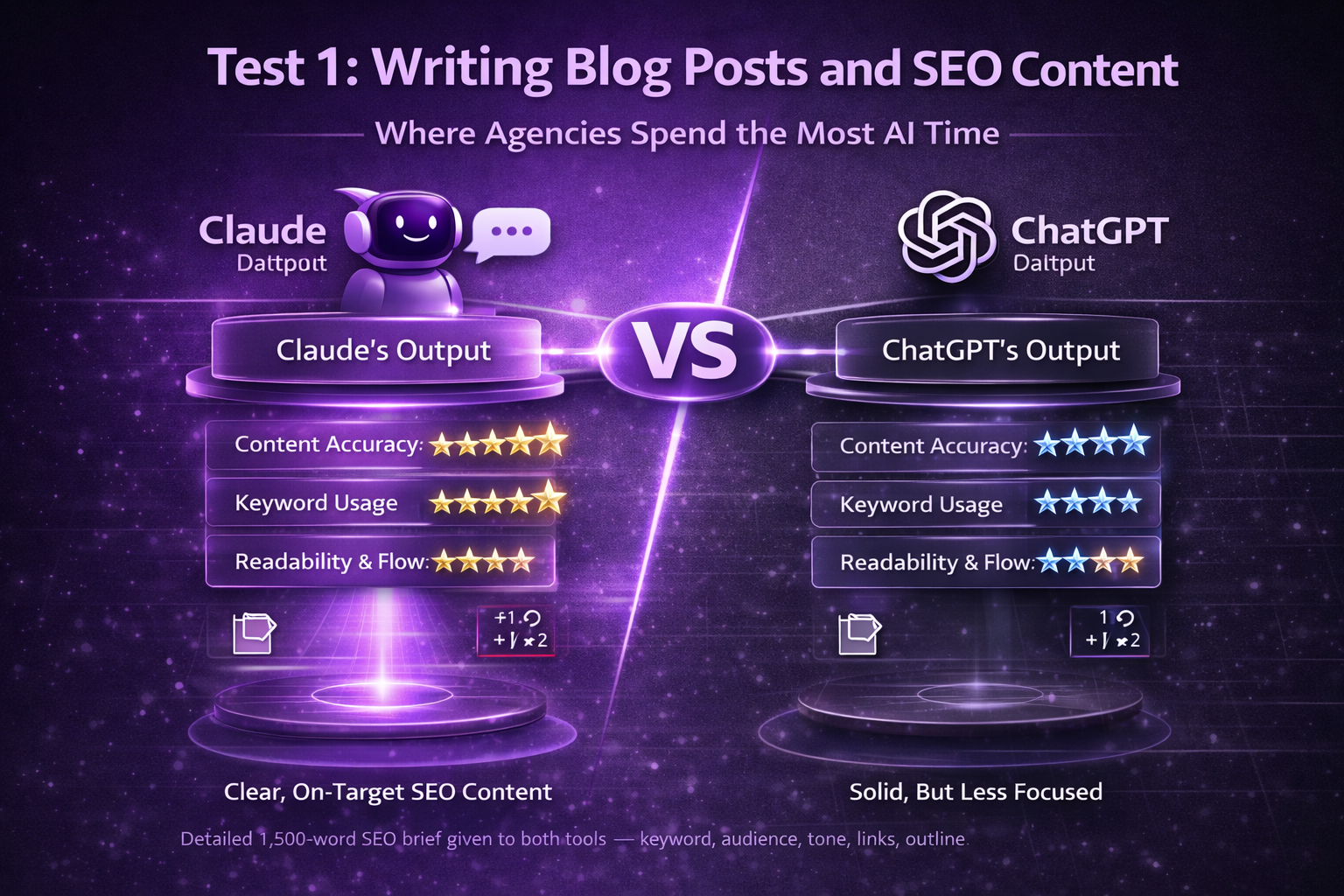
Claude vs ChatGPT for writing blog posts is the comparison that matters most to content-heavy agencies and where the practical gap is widest.
We gave both tools a 1,500-word SEO brief: target keyword, secondary keywords, audience persona, tone guidelines, internal link anchors, and a structured H2/H3 outline. The brief was detailed and specific. That specificity was the test.
Claude’s draft followed the brief almost exactly. The heading structure matched our outline, the transitions between sections felt logical, and — perhaps most tellingly — the opening paragraph did not start with ‘In today’s fast-paced digital landscape.’ The output required light editing for brand voice but was structurally ready to publish. We submitted a version of it, lightly edited, to a client the same day.
ChatGPT’s draft was technically strong. Factually accurate, well-structured in its own way. But it defaulted to its own preferred structure rather than the one we provided. The tone was more formal and uniform — which works for informational content but flattened the brand voice we were going for. Getting it to match our outline required a second prompt and another iteration.
Over a week of producing four articles, that 15-minute difference becomes a full hour of recovered claude ai for business productivity. Over a month, four hours — with no change to your subscription cost. This aligns with what Zapier’s updated 2026 Claude vs ChatGPT comparison found: Claude is the stronger choice for in-depth writing and coding projects, while ChatGPT is better for quick searches and web-native tasks that require breadth rather than depth.
Test 2: Social Media Content Creation
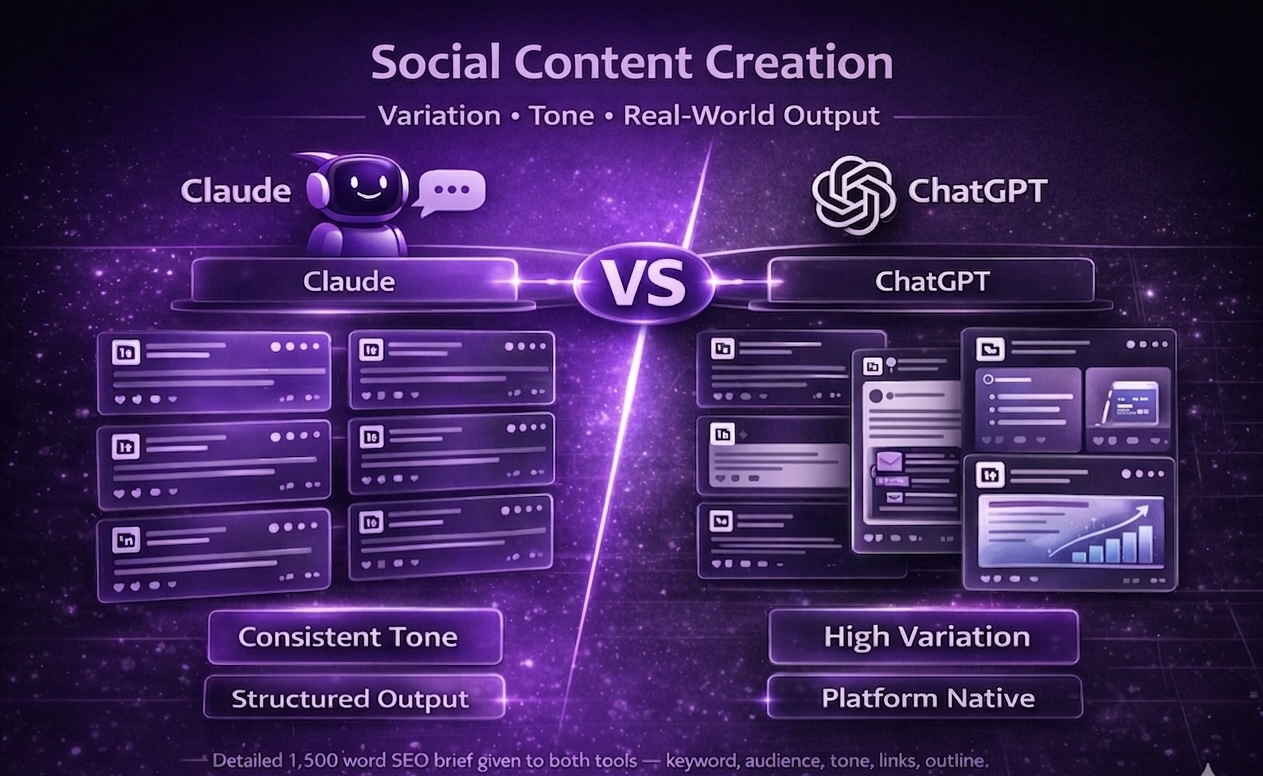
Claude’s five posts read like they were written by someone who has actually done the job. Paragraph rhythm that varied post to post. Opinion-driven hooks that invited real engagement. One of the posts we submitted almost without editing — the structure, the angle, and the opening line were all right on the first pass.
ChatGPT produced a recognisable pattern across all five: bold opener, numbered list or bullet structure, motivational closer. That formula dominated LinkedIn in 2023. In 2026, most professional audiences identify it immediately as AI output. We reworked three of the five posts before they were client-ready.
For Claude vs ChatGPT for social media content creation at high volume Instagram Reels captions, TikTok copy, X posts — ChatGPT’s speed advantage becomes relevant again. The variation it produces in a single prompt is genuinely useful for content calendars that need fifteen caption options to A/B test across platforms.
Test 3: SEO Strategy and Keyword Research
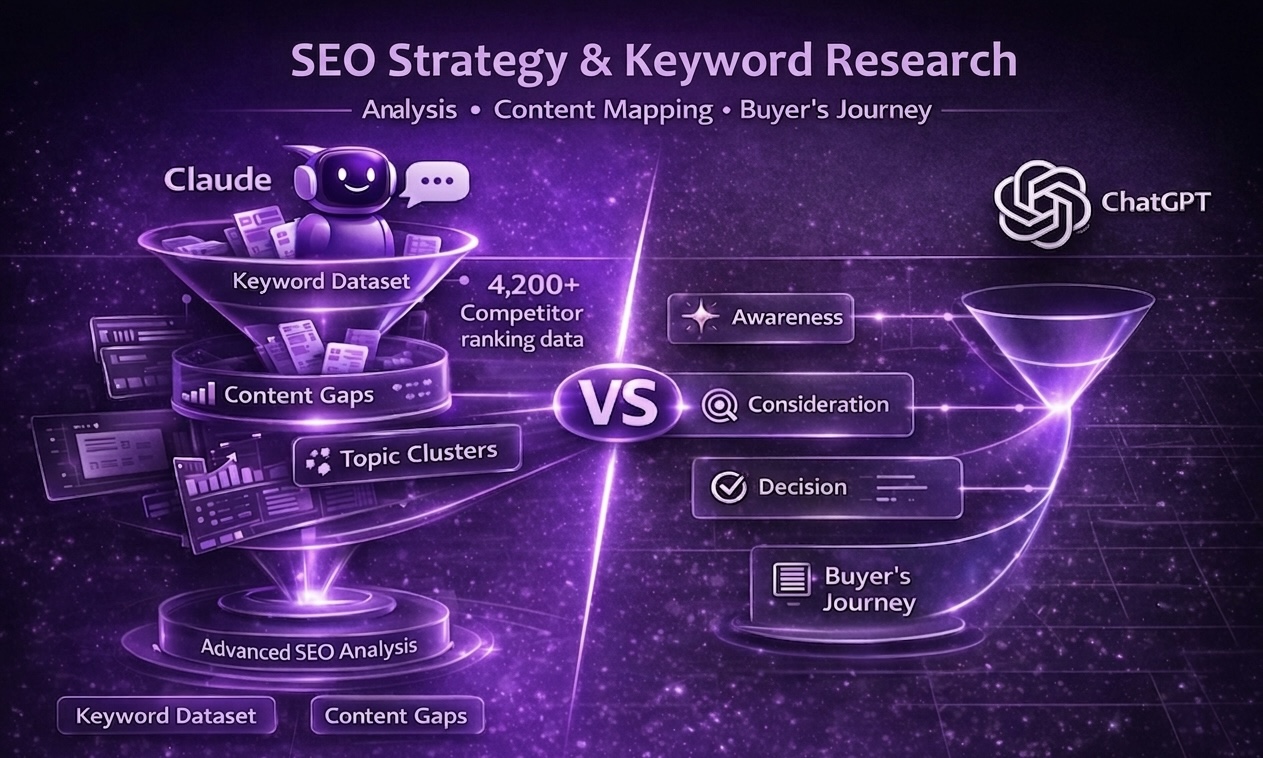
Is Claude better than ChatGPT for SEO? The nuanced answer is: it depends which part of the SEO workflow you are in.
For analysis and strategy — interpreting a keyword dataset, identifying content gaps, mapping a topic cluster, building a six-month content calendar- Claude is significantly more capable. We fed it a full SEMrush export: 4,200 keyword rows, competitor ranking data, and search intent classification. In one conversation. Claude processed all of it, identified the highest-priority content gaps, mapped them to buyer intent stages, and produced a structured six-month editorial plan with recommended H1s for each article. The whole workflow took 35 minutes.
ChatGPT’s standard context window (128K tokens) makes that kind of large-document analysis impractical without chunking the data across multiple prompts each with its own risk of losing continuity and nuance. For the same task, we needed three separate conversations and a manual synthesis step.
For high-volume keyword ideation — generate me 80 long-tail variations of this seed keyword, or write me 40 meta descriptions for these product pages — ChatGPT is faster. Its output velocity on repetitive generation tasks is genuinely quicker.
The optimal setup, which Search Engine Journal has documented, is to use Claude for the thinking layer (intent analysis, content strategy, gap mapping) and ChatGPT for the production layer (meta descriptions at scale, keyword list generation, title variation). Claude or ChatGPT better for SEO content? Claude for strategy. ChatGPT for production volume.
Test 4: Ad Copy and Email Marketing Campaigns
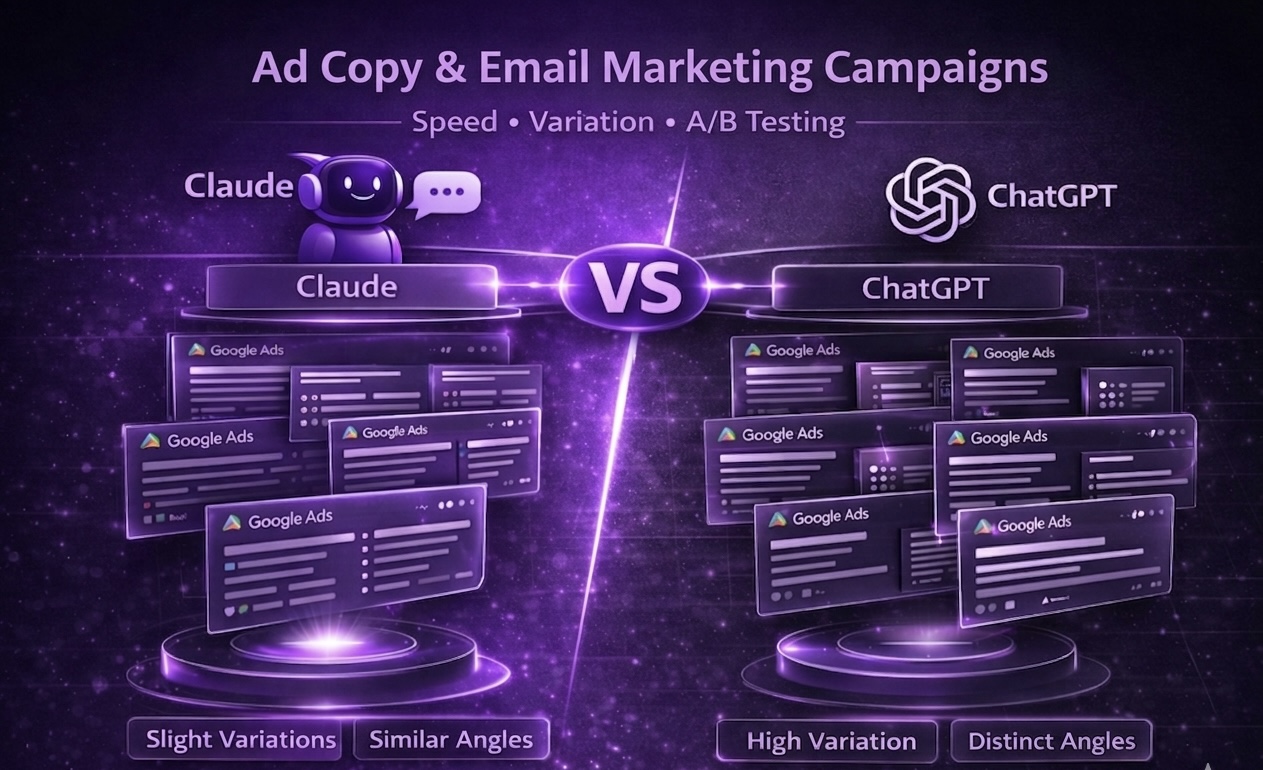
ChatGPT vs Claude for marketing copy specifically paid advertising has one structural outcome that is hard to argue against: ChatGPT wins on variation speed.
We asked both tools to produce five sets of Google Responsive Search Ad copy for the same campaign: three headlines and two descriptions per set, each targeting a genuinely different audience angle. ChatGPT produced five meaningfully distinct sets in a single output different hooks, different emotional registers, different calls to action. This is exactly what performance marketers need for A/B testing: not synonym replacements, but angles that test genuinely different conversion hypotheses. Claude produced good copy but with less genuine angle variation per prompt, requiring follow-up prompts to achieve the same breadth.
For email marketing, the balance shifts. Claude writes warmer, more specific email prose. When we gave both tools the same brief for a re-engagement email to dormant enterprise clients, Claude’s output read like it was written by a human account manager who knew the client’s history. ChatGPT’s output was correct and professional but noticeably templated — the kind of email that gets mentally filed as “marketing” rather than “personal outreach.” For a high-stakes enterprise reactivation campaign where a single email could recover $30,000–$50,000 in contract value, Claude’s quality premium is worth the slower pace.
For bulk email sequences six-email nurture campaigns, five-step onboarding flows — ChatGPT’s speed wins. The quality difference at that volume does not justify the extra time.
Test 5: Claude vs ChatGPT for No-Code Automation Workflows (Make.com, n8n, Zapier)
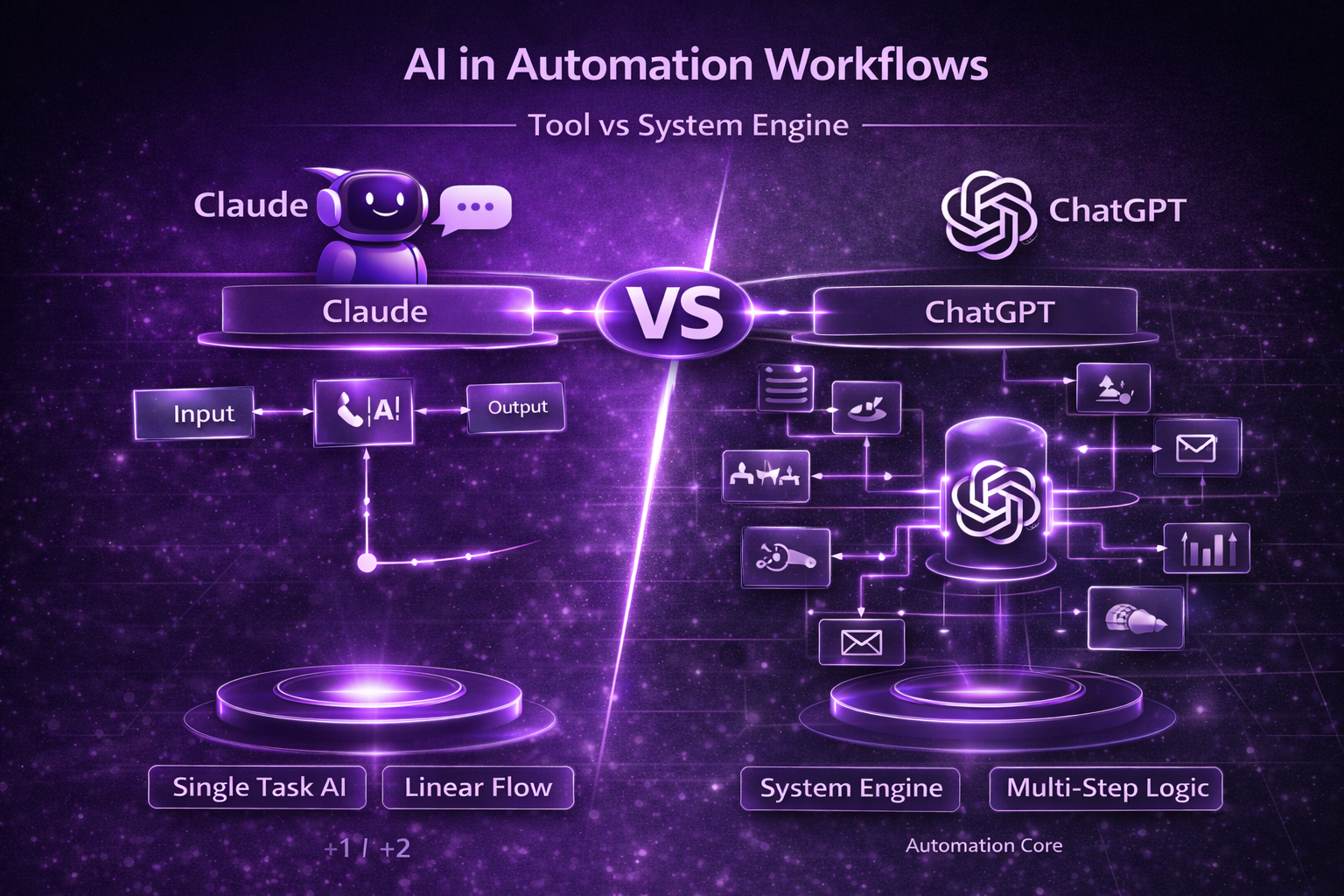
Claude vs ChatGPT for no-code automation workflows is not one question. It is two: are you using pre-built integrations, or are you building custom agentic systems? The answer to that question determines which tool is right for you.
For pre-built integrations Zapier’s native AI actions, connecting AI to existing tools with minimal custom development ChatGPT is faster to get started. Its larger ecosystem means most common agency tools (HubSpot, Slack, Google Sheets, Notion) are available as one-click connections. If you want AI summarisation in Slack or auto-generated first-draft replies to inbound CRM leads, ChatGPT inside Zapier is functional and quick to configure without any custom work.
For custom-built agentic workflows — where an AI agent reads a client brief, extracts structured data, generates a deliverable, formats it for a specific output template, routes it to the right team member, and logs the action — Claude’s instruction precision becomes critical. We have built and tested parallel automation workflows using both APIs inside Make.com for real client projects. In multi-step scenarios with more than four sequential actions, Claude completes the sequence with fewer hallucinations and significantly less prompt engineering overhead. In an automated workflow running unattended overnight, that behavioural reliability is the only metric that matters.
On API pricing, ChatGPT is cheaper: $2.50 per million input tokens versus Claude’s $3.00, and $10 versus $15 per million output tokens. For high-volume simple automations, that difference is real. For complex multi-step workflows, Claude’s lower error rate often makes it more cost-effective overall when retry and correction calls are factored into the total.
Is Claude or ChatGPT Better for SEO Content in 2026? The Full Answer
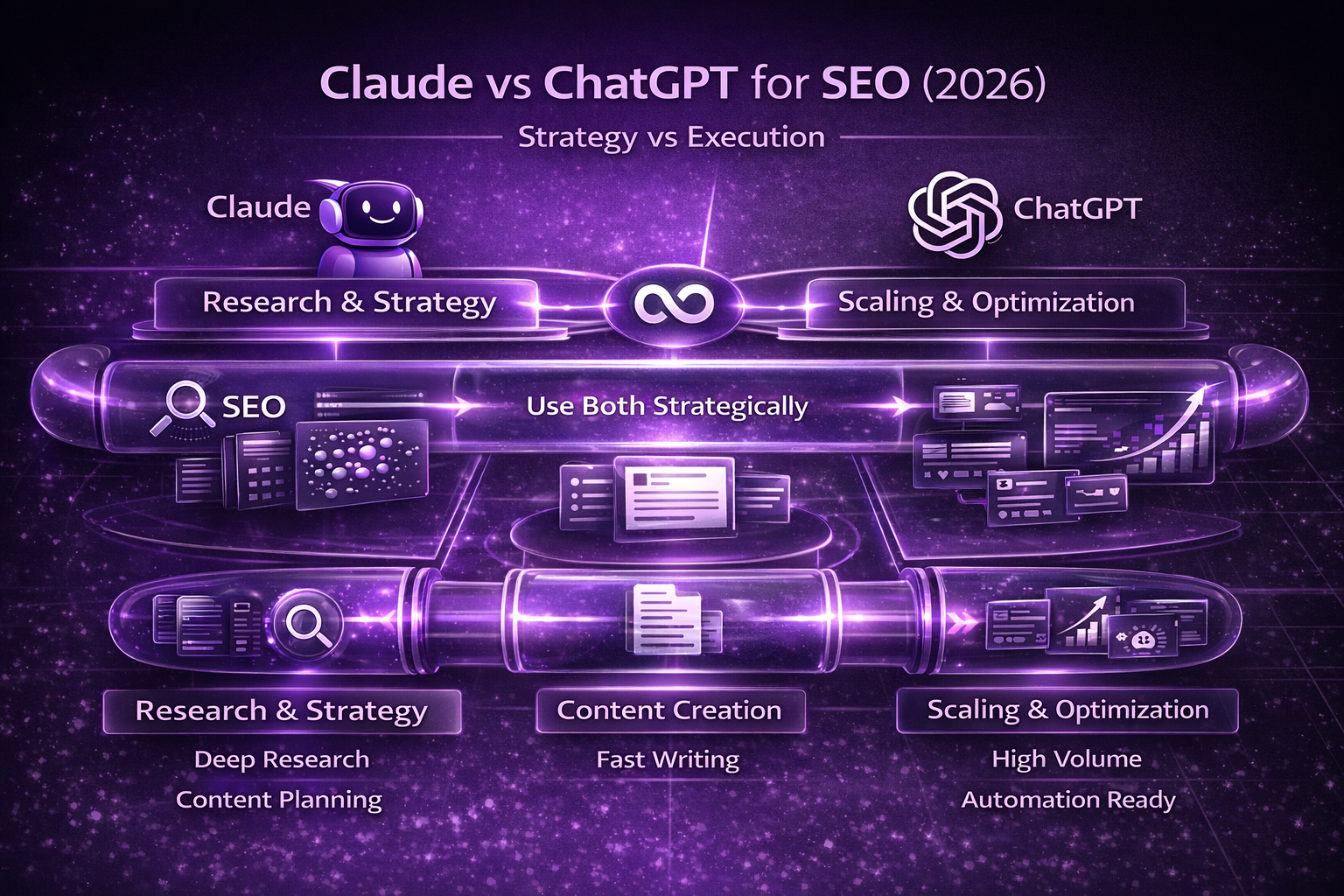
Is Claude or ChatGPT better for SEO content is the question we hear most from agency owners and SEO leads and the “it depends” answer, while technically accurate, is practically useless to someone trying to build a workflow today.
Here is the specific, layered answer:
Layer 1: Long-Form SEO Article Writing
Claude is better. The instruction-following precision means it produces drafts that match your content brief structure, keyword placement requirements, and tone guidelines more faithfully than ChatGPT does on the same brief. The editing overhead on a non-compliant AI draft often takes longer than the original writing would have — and Claude consistently produces more compliant first drafts.
Claude’s writing also avoids the AI-generated patterns that Google’s 2026 algorithm updates are specifically targeting. According to Google’s own guidance on creating helpful content, their systems evaluate whether content demonstrates genuine knowledge through lived experience rather than merely summarising what others have said. Claude’s reasoning-first approach produces outputs that are easier to build genuine editorial perspective on top of — which is what separates rankable content from filtered filler in 2026.
Layer 2: SEO Strategy and Analysis
Claude is better and significantly so on large datasets. The 200K context window is decisive when you need to process a full keyword export, a competitor backlink profile, and months of Search Console data in a single analytical pass. Claude or ChatGPT better for SEO content strategy work — Claude, every time, without qualification.
Layer 3: High-Volume SEO Production
ChatGPT is faster. Title tag generation at scale, meta description sets for e-commerce category pages, FAQ schema content for large sites ChatGPT’s speed and variation make it the more practical tool for these tasks. The quality difference at this production layer is not significant enough to justify Claude’s slower pace.
The agencies ranking consistently well in 2026 are running a three-layer SEO workflow: Ahrefs or SEMrush for data collection, Claude for analysis and long-form content, and ChatGPT for production volume. Each tool does what it does best. That is the full answer to is Claude or ChatGPT better for SEO content — and it is a “both, deliberately” answer, not a “either/or” one.
Claude vs ChatGPT for No-Code Automation: The Agency Owner’s Complete Guide
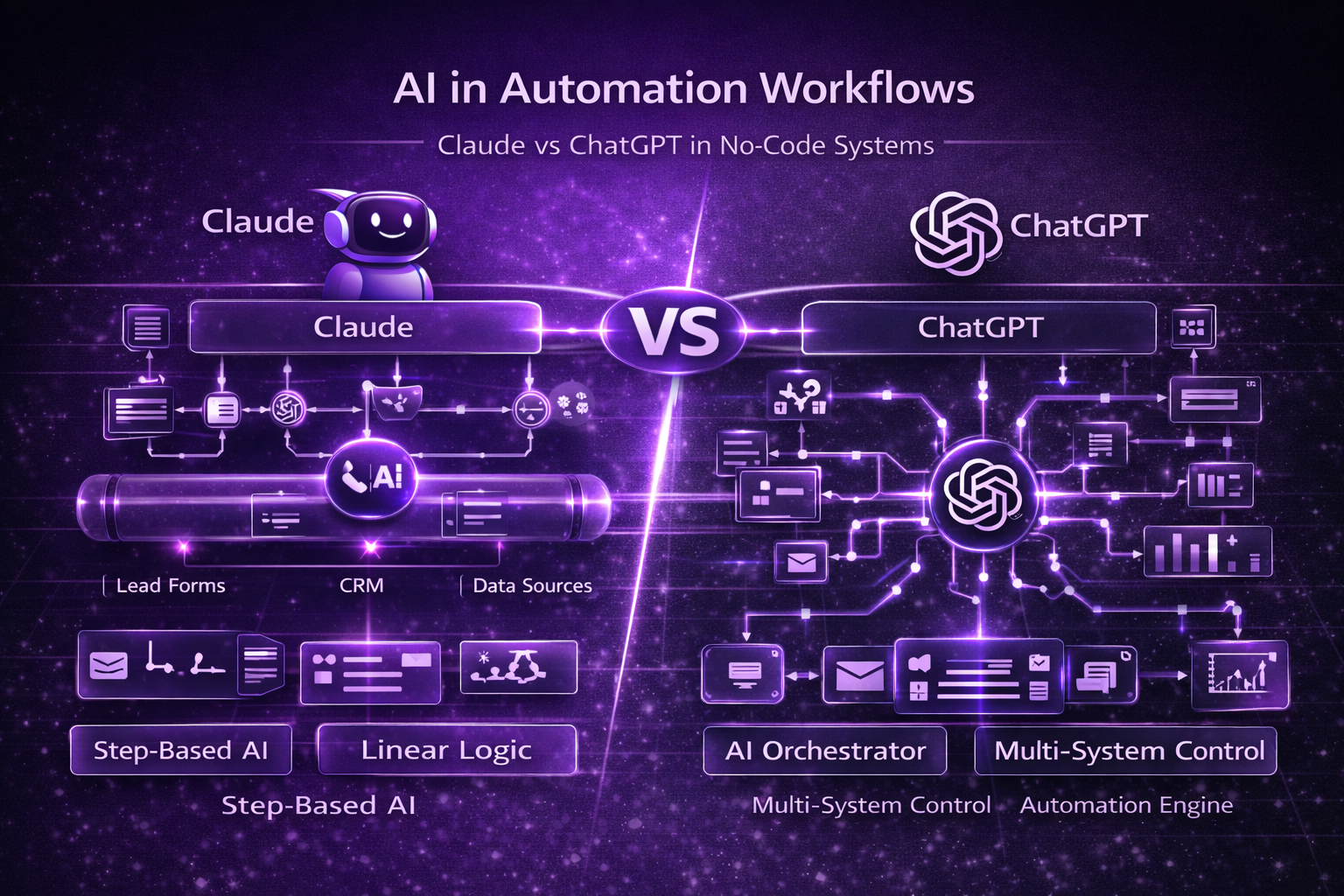
Most comparison posts end at “ChatGPT has more integrations.” That is accurate but incomplete. For agencies building real automation infrastructure, the more important question is: what kind of automation are you building?
Zapier: ChatGPT’s environment
Zapier’s native AI actions are optimised around OpenAI’s models. For plug-and-play use cases — AI summarisation in Slack, auto-categorised lead routing, triggered email draft generation — ChatGPT is the fastest path from idea to working automation. You configure, not code. For the claude vs chatgpt for no code automation workflows question at the Zapier level, ChatGPT wins on convenience and ecosystem breadth.
Make.com: Where Claude’s precision pays off
In Make.com scenarios with more than three sequential AI-dependent steps, Claude’s instruction precision creates a visible, practical difference. In complex scenarios — client onboarding flows, multi-source data synthesis, automated report generation with conditional routing — Claude completes sequences with fewer errors and requires less prompt engineering overhead. For agencies doing serious workflow builds, this is where claude vs chatgpt for no code automation workflows tips decisively toward Claude.
n8n: Both viable, context window decides the ceiling
n8n supports both APIs equally via HTTP nodes. The practical differentiator is Claude’s context window: you can pass more background information per API call, simplifying the logic for automations that process long documents like contracts, briefs, or research reports.
For teams building serious AI-powered automation, Gonzo’s No-Code Automation Services cover exactly this kind of architecture. We evaluate the claude vs chatgpt for business engine choice for every client project based on their specific workflow requirements — not on brand loyalty.
Ready to Build an AI Marketing Stack That Actually Delivers?
Understanding claude vs chatgpt for business is the strategic starting point. Building a workflow where Claude and ChatGPT are each doing what they genuinely do best automatically, reliably, without your team making that decision fresh every morning is the step that changes your agency’s output capacity and margins.
At Gonzo Digital, we help digital marketing agencies across the UAE, UK, US, Singapore, and Australia design and build AI-powered automation systems. From client onboarding pipelines to SEO content workflows to social scheduling systems, we build the infrastructure that turns AI capability into consistent, scalable agency output.
If your team is spending more than 15 hours per week on tasks that the best AI tool for business 2026 should be handling, that is a workflow architecture problem — not a tool problem. It is one we solve every day.
The most dangerous thing you can do is choose based on which platform sounds more impressive. Choose based on what your team will actually execute on six months from now.
Q: How does Claude compare to ChatGPT for agencies?
Ans: It depends entirely on task type. Claude wins on long-form content, large document analysis, and complex automation. ChatGPT wins on ad copy variation, image generation, and Zapier integrations.
Q: Is Claude or ChatGPT better for SEO content?
Ans: Claude for strategy, long-form writing, and large-dataset analysis. ChatGPT for high-volume production tasks like meta descriptions and title tags at scale. The optimal SEO workflow uses Claude for the thinking layer and ChatGPT for the production layer.
Q: Should I use Claude or ChatGPT for my business?
Ans: Use Claude if long-form content, large datasets, and custom automation are your core work. Use ChatGPT if you need images, voice, volume copy, or Microsoft integrations. Use both deliberately if you run a full-service agency. The right answer is rarely either/or in 2026 — it is a clear task assignment for each.
Q: What is the difference between Claude and ChatGPT pricing?
Ans: Both cost $20/month at the Pro and Plus tier — a deliberate pricing tie. ChatGPT has a cheaper $8/month Go plan for occasional users. At the API level, ChatGPT is cheaper ($2.50 vs $3.00 input, $10 vs $15 output per million tokens).